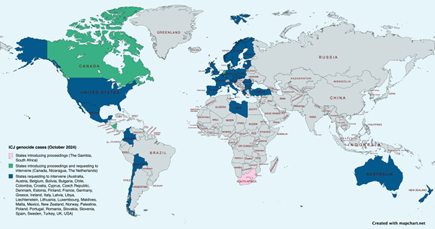
Genocide and armed conflict before the International Court of Justice

1. Introduction
Four cases have been brought before the International Court of Justice (ICJ or the Court) within as many years, all concerning alleged violations of the 1948 Convention on the Prevention and Punishment of the Crime of Genocide in the context of armed conflicts or occupation. The cases, concerning Myanmar, Ukraine, and Gaza, have all garnered significant scholarly and media attention. However, the Court’s provisional measures orders in South Africa v Israel[1] (alongside other Palestine-related contentious and advisory proceedings[2]) has brought the sharpest controversy, inside and outside the Court, raising questions as to the proper judicial role of the Court. These concern the role of the ICJ’s dispute settlement function in adjudicating claims arising from ongoing armed conflicts and complex political situations, and the role of the Genocide Convention as a basis for such claims.
Some have questioned if this forces the Court into ‘the delicate area of crisis management’,[3] or ‘micromanaging the hostilities’,[4] or asserted that the principal judicial organ of the UN should have ‘no role to play’ in situations of such political complexity as Gaza.[5] Others suggest the Gazan genocide case is an essential exercise of the Court’s mandate, offering a rare degree of hope – for the protection of civilians,[6] to ‘chart a path in the midst of the worst horrors’[7] or indeed for the future of international law. Is the ICJ dabbling dangerously with ‘mega-politics,’ or just doing its job? Are the Court, and the Genocide Convention, being instrumentalised and politicised, or is this business as usual for the Court?
This contribution responds to several questions arising from this flurry of claims and controversies. It does so principally by contextualising the new wave of genocide cases before the Court, and the Gazan Genocide case in particular, in several ways. Section 2 flags some novel features of the recent cases, and the trajectory of which they form part. Qualitatively, this includes the nature of the actors and engagement with the Court, and how States characterise their resort to the Court in legal terms. Quantitively, it includes not only the increased volume of cases being brought, but a shift towards exploiting the preventive potential of the law and process. In particular, the invocation of provisional measures is one way in which litigators increasingly seek timely interventions from a system not renowned for speedy justice.
Section 3 then focuses on questions that have arisen in relation to reliance on the Genocide Convention, including in conflict situations. Recognising the remarkable number of cases before the ICJ that have relied on the 1948 Convention to litigate responsibility of States for alleged violations during conflict, we note that various factors contribute to this increased engagement. These include limitations in the Court’s jurisdiction, as well as factual, normative and strategic considerations. We query whether resort to the Genocide Convention, even if influenced by limits on the Court’s jurisdiction, raises principled objections, as opposed to questions of fact and law for the Court’s determination.
Section 4 then contextualises the new wave of genocide cases by questioning the ICJ’s role in situations of armed conflict and occupation.[8] Our reflections are based on a detailed analysis of the ICJ’s involvement with conflict-related dispute settlement during the nearly 80 years since its establishment.[9] On this basis we conclude that the recent cases emerge from, and build on, the ICJ’s longstanding and diverse engagement in situations of armed conflict. The recent wave of genocide cases develop the role the Court has long played in conflict, and form part of the broader reinvigoration of ICJ judicial activity of the past five years.
Section 5 addresses related concerns regarding the role of the Court in politically contentious contexts. We find that the Court’s practice, and arguments of principle, fully support the engagement of the ICJ in settling disputes that are legal in nature, but arise in contexts of crisis or conflict.
In the final section, we contextualise the ‘strategic’ use of the Genocide Convention and the Court within the longstanding practice of strategic litigation in international adjudication. We offer concluding reflections on the role of the Court and its significance, in dynamic relationship with, and complementary to, the roles of political actors.
2. Novel features of the new wave of genocide cases
One question is to what extent the pending genocide cases are different in nature from those that preceded them, raising novel features or objections. In this section we note at the outset what appear to be some newer procedural features that are relevant to the debates and controversies that we address in this contribution.
In stark contrast to the multiple allegations of genocide brought by States of the former Yugoslavia, that were the first genocide cases before the Court,[10] the applicants are no longer only the States directly affected by alleged violations of the Convention’s rights, but also States parties acting based on a shared interest in ensuring compliance with the erga omnes partes obligations enshrined in the Genocide Convention. This doctrine enables any State party to the Convention, regardless of the existence of harm or a special interest, to bring a case before the ICJ against a State accused of violations to enforce compliance with the Convention’s obligations. This form of what might be termed ‘public interest’ or ‘strategic’ litigation by States (see Section 6) has enabled violations occurring during several non-international armed conflicts, or egregious wrongs to a State’s own nationals or persons without the protection of a State, to be brought before the Court, which would not have been possible otherwise. This includes for example the violations during the ongoing conflict in Myanmar’s Rakhine State opposing Myanmar’s armed forces and the Arakan Rohingya Salvation Army. Similarly, the Court’s engagement with the situation in Gaza in 2024 was made possible by the willingness of South Africa to bring a claim in the collective interest, given Palestine’s contested standing to do so.[11]
Litigation in the public interest is not limited to enforcing the Genocide Convention and applies to other multilateral treaties safeguarding common interests. However, it holds particular significance in the context of the 1948 Convention because of States parties’ explicit obligation to prevent genocide, and the gravity and significance of the wrongs. It is noteworthy that both South Africa and Nicaragua in their claims related to violations of the Convention by Israel and Germany respectively, conceptualised the filing of their applications instituting proceedings as a way for them to fulfil their own obligations to ensure respect for the Convention and to prevent genocide.[12] This appears to be a new development, and a potentially significant reframing of the role of States as litigants before the Court – with an emphasis on the enforcement of international law, not only their own interests.
It is also worthy of note that this new wave of litigation may signal a shift towards seeking to use the litigation process to influence conduct in real time; in other words, to exploit the preventative potential and promise of the Genocide Convention. Increasingly, as noted below, we see the Court being seized not only to settle disputes and pronounce on the responsibility of the belligerents ex post facto, as was the case with the bulk of the conflict cases of the past (see section 4),but also to intervene in real time, effectively clarifying and insisting on standards of conduct relevant to unfolding allegations and drawing red lines for the conduct of conflict.
This effort to secure timely engagement is perhaps seen most clearly through the growing requests to the Court for urgent provisional measures. Such requests have not only grown in volume, but orders have diversified in nature.[13] Notably, the Court has ordered one of the parties to cease their military operations in another State or an area thereof,[14] to refrain from certain conduct,[15] or to take specific action to alleviate the humanitarian situation on the ground during ongoing hostilities.[16] Another request sought the suspension of military assistance, including military equipment, which the Court declined on the facts, but indicated it was remaining attentive.[17] Notably, in Gazan Genocide the Court ordered increasingly more detailed and robust provisional measures as Israel’s offensive in Gaza was mounting due to Israel’s non-compliance with the Court’s earlier orders, and the intensifying crises on the ground.[18]
The search for timely rulings by the Courts on requests for the indication of binding measures in urgent situations, as seen in the Gazan Genocide case,[19] may well be one of the factors that is driving applicants to the ICJ. It may also render provisional measures proceedings and orders equally – if not more – significant than the ultimate adjudication of the dispute on the merits, years after the institution of proceedings.[20] The lower standard for the indication of provisional measures compared to the merits phase – requiring applicant States to show that the Court has prima facie jurisdiction only, and the plausibility of the claim – may also feature amongst the strategic considerations for submitting requests for the indication of provisional measures.
3. Jurisdictional objections to the framing of allegations as ‘genocide’
Objections to the Court’s adjudication of genocide claims, including in armed conflict situations, are not new. In the past, objections pertained to the suitability of ICJ as a forum to adjudicate interstate claims, motivated by a construction of the Genocide Convention as geared towards the prevention or punishment of genocidal acts committed by individuals.[21] Others advanced the view that the Court was not the proper venue to determine whether genocide was committed.[22] Those early critiques have, however, largely been settled with the development of understanding around State and individual responsibility in international law, and the role of the Court. Moreover, it is also now well established that there can and often has been concurrent responsibility, and jurisdiction, for example between ICJ and ICL tribunals.
More recently, concerns have been presented as jurisdictional objections – that the Court is assuming jurisdiction over violations in conflict through overly broad interpretations of the Genocide Convention. In her dissent in Gazan Genocide, Judge Sebutinde noted that the conduct of the belligerent parties in the Israel-Hamas war is regulated by IHL and IHRL, two bodies of law over which the Court lacked jurisdiction.[23]
By way of background, it is worth recalling that the Court’s jurisdiction in contentious cases is indeed extremely limited. It is based on the consent of States parties, which can be expressed in various ways. One is by accepting compromissory clauses, which grant the Court jurisdiction to resolve disputes relating to the interpretation and implementation of the relevant treaty.[24] This is the case with Article IX of the Genocide Convention, Article 22 CERD and Article 30 CAT. By contrast, no humanitarian law treaty contains a similar clause conferring jurisdiction on the ICJ. Undoubtedly, as Greenwood noted, this has ‘seriously limited the ability of the Court to rule on issues of IHL.’[25]
Absent treaty-based jurisdiction, optional clause declarations could provide such a basis to adjudicate IHL violations in conflict. However, few States have made optional clause declarations that remain in force (only 74 States, with the United Kingdom as the only UNSC permanent member, have done so). Some States have specifically excluded claims arising out of armed conflict from their scope. Some broadly exclude any dispute relating to armed conflict or hostilities,[26] while others exclude disputes relating to the use of nuclear weapons,[27] self-defence,[28] occupation, the use for military purposes of the territory of the State and the deployment of armed forces abroad,[29] or collective military operations within the UNSC or other organizations.[30] Considering that, in addition, acceptance of ICJ jurisdiction on the basis of optional clause declarations has to be reciprocal, those exclusions significantly limit the Court’s ability to adjudicate disputes on this basis. Unsurprisingly then, there are only two cases in the history of the Court in which jurisdiction was based on the parties’ optional clause declarations,[31] while a third case (Nicaragua v Germany, in relation to Israeli operations in Gaza) is currently pending.[32]
Against this backdrop, it is perhaps unsurprising that historically the Genocide Convention has been so often invoked by States to bring cases before the ICJ regarding alleged breaches of international law in situations of armed conflict. In fact, there have been 17 cases to date in which the applicant State invoked the jurisdiction of the Court to resolve disputes relating to the interpretation and application of the Genocide Convention based on its Article IX.[33] This stands in contrast to only four cases brought under the CERD[34] and three under the CAT.[35]
In some contexts, this has led to accusations of over-reliance on the 1948 Convention and ‘shoehorning’ allegations into the Genocide framework, as Russia claimed in Ukraine v Russia, where allegations concerning Russian aggression were framed as violations of the Convention for jurisdictional reasons.[36] Similar concern has been raised in relation to the recent practice of using the CERD to address alleged violations in situations of armed conflict.[37] Ultimately, however, objections in respect of the framing of allegations should be addressed by refuting them on points of law and fact.
The fact that the Court does not have contentious jurisdiction over IHL and IHRL, the two branches of international law regulating the conduct of belligerents in armed conflict, does not logically mean it cannot adjudicate other violations arising in conflict situations. The ability to bring a genocide claim, provided the elements of genocide are met, cannot logically be impeded by the fact that other allegations of IHL and IHRL violations cannot be brought. Fragmented acceptance of jurisdiction, outlined above, certainly reveals States’ resistance to judicial oversight in conflict. It impacts on the Court’s function, which cannot take a holistic view of the range of violations. It may in some cases lead to some distortion, shoehorning or at least selectivity in respect of impugned facts and legal arguments, that may not otherwise have been viewed through the prism of the Genocide Convention (as the Ukraine v Russia case suggests), at least not exclusively. But the widespread refusal of States to make optional clause declarations for conflicts does not mean that the Court cannot exercise the jurisdiction it does have, through treaty, to adjudicate issues of genocide, racial discrimination or torture, whether they arise in armed conflict situations or not.
The stakes in genocide cases are undoubtedly high because of the seriousness of the allegations and their symbolic force. Objections to the framing of violations in conflict as ‘genocide’, including the perhaps unprecedented level of indignation and opposition to the claim in relation to Gaza, reflect this.[38] But the Court’s Statute offers ample procedural safeguards for the respondent to challenge any allegedly improper framing of facts as genocide, such as the filing of preliminary objections, as the outcome of the Ukraine v Russia case shows.[39] Other than that, it is for the Court to decide whether , on the facts and evidence, allegations are proved to the requisite standard of proof.
4. Contextualising the Court’s role in armed conflicts
We now focus on the argument that the ICJ, as the principal judicial organ of the UN, has ‘no role to play’ in ongoing hostilities, and should be cautious not to become a ‘micromanager’ of armed conflicts.[40] As Rosenne and others observed, the Court may be forced ‘into the delicate area of crisis management’.[41] We contend that the Court’s detailed engagement with the hostilities in Gaza, and the Occupied Palestinian Territories (OPT) more broadly, builds on its established practice adjudicating conflict-related cases, and reflects its increasingly robust role in engaging with facts and evidence in this context in recent years.
The Court has actively engaged in conflict scenarios since its establishment, addressing a broad array of issues, ranging from allegations of genocide and racial discrimination, jus ad bellum, occupation, frontier disputes at the heart of conflict, and the legality of nuclear weapons. To date, the ICJ has issued seven merits decisions in contentious cases arising out of active conflicts, one judgment on a request for interpretation,[42] one judgment on reparation for wartime damage,[43] and a remarkable 33 decisions on provisional measures.[44] Even these considerable figures do not, however, do justice to the Court’s engagement with armed conflict, as there are many more cases that ended at the preliminary objections stage,[45] or were discontinued.[46] The Court has also rendered seven advisory opinions related to armed conflict, of which four were in relation to South West Africa/Namibia[47] and two concerned Palestine.[48] A further request related to Israel’s obligations concerning the OPT is pending at the time of writing.[49]
The Court has therefore engaged actively in conflict scenarios, including with the Israeli-Palestinian conflict. While it has done so since its establishment, the nature of that involvement has evolved quantitatively and qualitatively over time. We have identified three phases in the Court’s history that are characterised by different trends.
First, for almost half century (1946-1989), conflict was in the background, rather than at the forefront, of the cases before the Court. This was true of some of the earliest cases that dealt with the legacy of the League of Nations mandate system or a violent colonial past,[50] the treatment of POWs,[51] or frontier disputes leading to violent confrontations.[52] The Nicaragua case, dealing with the legality of the US interference in the NIAC between the contras and the Nicaraguan government, marked a shift to greater involvement with conflict.[53] Here the Court made important contributions on a broad range of issues (the lawfulness of the threat or the use of force, self-defence, attribution and conflict classification) thanks to the fact that its jurisdiction was based on the parties’ optional clause declarations.
Quantitatively, since the 1990s, there has been a marked increase in the number of cases on human rights and IHL related issues in armed conflict (alongside a more general increase in the ICJ’s judicial activity). In the period 1990-2019, the Court was also much more directly engaged with cases concerning the legality of the belligerents’ conduct in active conflicts (even if not necessarily under IHL). The Court engaged with conflicts in the former Yugoslavia,[54] the DRC,[55] Georgia,[56] Cambodia,[57] the lawfulness of weapons systems,[58] and the OPT.[59] These cases addressed a broad range of conflict-related issues, ranging from allegations of genocide and racial discrimination, jus ad bellum, occupation, frontier disputes at the heart of conflict, and the legality of nuclear weapons. A case concerning alleged transboundary harm caused during the conflict in Colombia was settled out of Court.[60] The Court also addressed jurisdictional questions related to the adjudication of international crimes committed during conflicts.[61]
In the last five years (2020-2024) there has been a further quantitative growth spurt in the number of cases brought before the Court generally, and those concerning conflict in particular. At the time of writing there are seven pending cases concerning conflict, four of which were initiated by States not directly affected by the internationally wrongful act to vindicate interests shared by the international community.[62] This figure shows that there has been a definitive shift away from the 1966 decision in South West Africa, in which the Court held that international law does not recognise ‘a right resident in any member of a community to take legal action in vindication of a public interest’.[63]
As noted above, a related phenomenon taking shape in this most recent phase of the Court’s activity relates to growing engagement of a range of actors within the judicial process. This is reflected in the recent wave of genocide cases and in Canada and the Netherlands v Syria.[64] Likewise, the rise in (mass) third-party interventions marks a shift from what was, until recently, a practice that was attempted sporadically and allowed even more sparingly.[65] Prime examples within conflict related contentious cases are the proceedings in Ukraine v Russia, in which an unprecedented number of States intervened,[66] followed by 13 requests for interventions in the Gazan Genocide case[67] and 11 in Gambia v Myanmar.[68]
Qualitatively, as was mentioned, one sees more often the Court being seized to influence the conduct of belligerents (or of States supporting them) in ongoing conflicts through the indication of provisional measures, rather than only or mainly to seek accountability for past violations. In this five year period alone, there have been 12 decisions on requests for the indication of provisional measures in seven cases, four of which concerning alleged breaches of the Genocide Convention. [69] This suggests that the Court’s current ‘conflict adjudication’ role, which South Africa’s case highlighted, is not unique to the conflict in Gaza, but is a broader trend across all recent cases arising from situations of armed conflict, including those in Myanmar, Ukraine, Nagorno-Karabakh, and Syria.
In sum, in our view the Court’s engagement with genocide in conflict, and practice in the Gazan Genocide case specifically, is consistent with its longstanding role in conflict situations, and more broadly with its reinvigorated role over the past five years.
5. The Court, conflict and (political) complexity
Finally, the Palestine-related litigation has raised questions regarding the role of the Court, as the principal judicial organ of the UN, in resolving disputes that concern politically complex situations and raise ‘political, military and public policy’ issues.[70]
The charge was led by dissenting judge Sebutinde in Gazan Genocide who noted that complex situations such as Gaza require diplomatic and political solutions,[71] and few would disagree that such solutions are long overdue. But her conclusion that the dispute between the parties was essentially political rather than legal, and not therefore susceptible of judicial settlement, is another matter.[72] Objections to the role of the Court in complex and sensitive political contexts, like its role in armed conflict, are unsustainable as a matter of principle and out of step with the Court’s practice.
First, it perhaps goes without saying that genocide has never arisen in a political vacuum. Intense political extremism and polarisation are common contextual features of the crime.[73] Moreover, genocide has almost always arisen in the context of armed conflicts (both international and non-international).[74] Any suggestion that the Court should refrain from considering genocide allegations in complex political situations including armed conflicts, would effectively deprive it of jurisdiction over the crime of crimes, at odds with the 1948 Convention.
More broadly, longstanding practice before the Court reveals that it has always adjudicated politically contentious disputes and contended with conflict-related politics.[75] Similarly, it is hardly unusual that, to meet the problems raised in international legal disputes, diplomatic and political solutions have been imperative, and often lacking. Fierce opposition and criticism of the Court’s rulings are not new either,[76] even if the intensity of States’ responses, expressed in response to its provisional measures orders in Gazan Genocide, was rare.
It is for the Court to resolve interstate disputes, applying international law, within its jurisdictional constraints. The Court has explicitly rejected, as others have noted, any ‘political question’ exception.[77] Such exceptions, and the doctrines of non-justiciability, are relevant – and controversial – in national courts, and have impeded the adjudication of allegations of serious violations in in Palestine. Notably, US Courts found they could not address the lawfulness of the Biden administration’s policy in respect of Gaza.[78] More significantly, Israeli courts refused to address serious allegations resulting from settlement expansion on the basis that they are non-justiciable (alongside statutes that remove jurisdiction, for example, for alleged war crimes in Gaza).[79]
Whatever their role on the national level, such doctrine does not apply internationally. The ICJ has made quite clear in the past that it ‘cannot attribute a political character to a request which invites it to undertake an essentially judicial task, namely, the interpretation of a treaty provision’.[80] While Sebutinde’s dissent has generated attention and response, it was a minority view. The vast majority’s approach, in granting provisional measures, was consistent with the Court’s statement two decades earlier, that: ‘whatever its political aspects, the Court cannot refuse to admit the legal character of a question which invites it to discharge an essentially judicial task’.[81]
It is fundamental to note the distinction between a Court being asked to determine a political question, and its essential role in determining legal ones, even when they are politically contentious.If the Court were to refuse to determine disputes on political grounds, it would fly in face of practice to date, undermine its credibility and universality and, paradoxically, politicise the essential legal function of the Court. It may feed growing concerns regarding selectivity in international law and practice, and the ‘exceptionalisation’ of the treatment of violations in Palestine compared to other contexts.[82] In this respect it is noted that some of these concerns seem to have been raised only in the context of Palestine, despite not being unique to the situation. For example, no members of the Court raised any objections to the Court’s handling of a complex political situation in the Croatian Genocide case, or in the context of allegations of genocide in Gambia v Myanmar. On the contrary, in Ukraine v Russia, Sebutinde (jointly with Judge Robinson) criticised the Court for adopting a restrictive interpretation of its jurisdiction under the Genocide Convention, which exposed militarily weak states ‘to the wanton might, use of force and, quite likely, impunity of a militarily stronger State party’.[83]
Complex power dynamics lie behind many if not most genocide cases, most conflict-related cases, and indeed most other cases before the ICJ.
6. ‘Strategic’ resort to the Genocide Convention in conflict and the role(s) of the Court
There are many reasons why a range of actors are increasingly focusing attention on the ICJ. These include of course the intensity of unfolding violations and the failure of political bodies, but also the role and authority of Court, its jurisdiction (including over genocide), and its potential impact on multiple levels. Some have praised the potential of a ‘strategic’ shift towards the World Court, and others questioned the role of States such as South Africa, Gambia, Canada, the Netherlands and Nicaragua that have brought such claims based on the erga omnes nature of the violations, acting in the collective interest.
Strategic resort to the courts is, once again, nothing new, but has been an area of burgeoning practice in recent decades. There has been a massive increase in resort to strategic human rights litigation (SHRL) by an array of different actors engaging in diverse roles, before diversifying fora. Litigation is by definition a tool to advance a range of goals, which correspond to diverse needs, interests and reparation of individual applicants, or to broader ‘strategic’ objectives such as strengthening law, influencing policy or practice.[84] The public interest litigation trend before the ICJ, based on collective interests and States obligations under several treaties including Genocide Convention discussed in section 2, forms part of this, albeit with a leading role for the community of States.
There is also nothing unusual about international litigation engaging with the conduct of armed conflict, and resulting violations of IHRL, IHL and other norms, as seen by human rights bodies and ICL tribunals increasingly engaging with accountability and reparation in armed conflict.[85] What is unusual is for this litigation to concern Israel on account of its refusal to accept the jurisdiction of human rights courts or bodies.
The ICJ is likely to continue to be called upon, alongside other bodies, to address many of the intractable legal problems arising around the globe, often in contexts where political solutions are proving elusive. As ever expectations should be realistic and carefully managed. But the Court can play, and has played, a variety of roles that complement each other, and can supplement and inform the actions of political actors.
First, through the settlement of interstate disputes arising from conflict scenarios, including those concerning the Genocide Convention, the Court exercises a normative function. It states the law regulating the conduct of the parties,[86] clarifies the obligations of different stakeholders (belligerents, allies, third States and international organisations), reaffirming their importance at times when those obligations are being put to the test. This function, which is independent of compliance with the Court’s pronouncements, is of critical importance to counter the perception that laws are silent in conflict or crisis, or that certain actors are beyond the law. It is not unique to contentious proceedings that are the focus of the present contribution, but also extends to advisory proceedings, even if not binding (as the two ICJ Advisory Opinions on the unlawfulness of the Wall and of the Occupation make clear).
While the Court’s primary function is to interpret and apply the law, it also contributes to legal development or clarification, and may do so through the pending genocide cases. For example, issues regarding the mens rea requirements for State responsibility for genocide, or the relationship between the Genocide Convention and IHL, are contentious in both Gambia v Myanmar and Gazan Genocide, and may be clarified by the Court.[87]
Second, ICJ proceedings perform a truth-telling function. They offer a platform for the airing of evidence about unfolding violations, as epitomised by the extensive evidentiary hearings in Gazan Genocide. Significant media attention to the Court in recent years amplifies this beyond the Great Hall of Justice and academic circles, to the communities the law serves.[88] This has been described as corresponding to Hannah Arendt’s vision of Courts as arenas for public debate on crucial moral and political issues of the time.[89] In turn, the Court’s pronouncements – whether on the merits, preliminary objections or requests for the indication of provisional measures – also contribute to shaping the narrative[90] This is especially important in face of conflicting narratives of those facts, which can themselves fuel divisions, as in the contexts of Ukraine and Gaza.
Third, it bears emphasising that the Court’s primary role in the exercise of its contentious jurisdiction is to settle disputes between the parties regarding their compliance or non-compliance with international law, to establish responsibility and pronounce on appropriate reparation. It thus has an important accountability function, albeit one subject to important limits. As was mentioned, these include the Court’s tight jurisdictional constraints and slow pace, and its effectiveness is seriously marred by non-compliance. Yet, authoritative judicial decisions, while certainly not resolving the problems, ensure a degree of recognition of wrongs which is in itself one form of accountability and of reparation. In addition, the Court’s pronouncements can have a catalytic effect on other accountability processes, both at domestic and international level, particularly given the authoritative role and standing of this Court.[91]
Fourth, especially in recent years, the Court’s engagement in adjudicating genocide during conflict speaks to the law’s relevance as a force in real time, to guide belligerents’ conduct during ongoing hostilities and prevent or stop atrocities, not only as a framework to be applied ex-post facto. Increasingly, this has taken the form of provisional measures orders. Undoubtedly, non-compliance is a serious problem that curtails the impact of this Court and indeed other international fora, and that needs to be addressed. But non-compliance does not exclude political and social impact. The Court’s provisional measures orders at a minimum send a message to, and increase pressure on, a range of relevant actors – belligerents on the ground, States directly involved and the third States upon whom they depend. In genocide cases, the indication of provisional measures – which is premised on the plausibility of the applicant’s claim – puts third States on notice of ‘the existence of a serious risk that genocide will be committed’,[92] which triggers their legal obligation to ‘employ all means reasonably available to them’ to prevent genocide.[93]
Finally, ICJ proceedings have an important expressive function. They assert the role and relevance of international law, at a time when it is under attack. They provide an opportunity for States (whether they are acting as applicant, respondent or intervening States) to engage international audiences and to signal their commitment to international law. The framing of disputed facts as legal arguments, particularly when the framing in question is genocide, holds a unique symbolic force. The act of appearing in the Great Hall of Justice to make submissions before the Court, with the world watching, speaks to the significance of the lawRather than obstructing a diplomatic settlement of the underlying political disputes or conflicts between the parties, through its multifaceted roles, the Court could directly and indirectly facilitate such a settlement. It is indisputable that its role is modest, and it will not resolve the situation of Palestine, but it has a role to play, that should not be stymied by the objections addressed in this chapter.
7. Conclusions
This contribution has shown that the Court’s engagement with genocide allegations in recent conflicts is consistent with its longstanding practice of involvement in situations of armed conflict since its establishment, and particularly with the more active role it has been playing in the past five years. We also show that the strategic use of the Genocide Convention may in some contexts be in part explained by the limits to the Court’s contentious jurisdiction when it comes to armed conflict situations, but that legal objections to the use of the Convention are misplaced. While it is clear that courts cannot resolve conflicts – as Judge Tladi aptly remarked, ‘the Court is only a court!’[94] – the notion that they have no role misrepresents their function. It reflects a dangerous assumption that judicial and political engagement are alternatives, or in conflict, as opposed to complementary.[95] This disregards the Court’s well-established tradition of engagement in adjudication, including in situation of conflict and crisis, where it is often needed most.
* Respectively Professor of International Humanitarian Law and Human Rights and Assistant Professor of Public International Law, Grotius Centre for International Legal Studies, Leiden Law School. The authors wish to thank Ciara Church for her research assistance.
[1] ICJ, Application of the Convention on the Prevention and Punishment of the Crime of Genocide in the Gaza Strip (South Africa v Israel) General List No 192 (henceforth ‘Gazan Genocide’).
[2] Alleged Breaches of Certain International Obligations in respect of the Occupied Palestinian Territory (Nicaragua v Germany) (Order of 30 April 2024) <www.icj-cij.org/sites/default/files/case-related/193/193-20240430-ord-01-00-en.pdf>; Legal Consequences arising from the Policies and Practices of Israel in the Occupied Palestinian Territory, including East Jerusalem (Advisory Opinion) 2024 <www.icj-cij.org/sites/default/files/case-related/186/186-20240719-adv-01-00-en.pdf>; Legal Consequences of the Construction of a Wall in the Occupied Palestinian Territory (Advisory Opinion) [2004] ICJ Rep 136.
[3] S Rosenne, Provisional Measures in International Law, The International Court of Justice and the International Tribunal for the Law of the Sea (OUP 2004) 218, cited in Zhenni Li, ‘Autonomy of Provisional Measures or Autonomy of the International Court of Justice?” (2023) 22 Chinese J Intl L 39, 42.
[4] Gazan Genocide (Order of 24 May 2024) Dissenting Opinion Sebutinde paras 1-2 <www.icj-cij.org/sites/default/files/case-related/192/192-20240524-ord-01-01-en.pdf>, arguing that to maintain its judicial integrity, the Court must avoid reacting to every shift in the conflict and refrain from micromanaging the hostilities in the Gaza Strip.
[5] S Talmon on X (9 April 2024) available at <https://x.com/StefanTalmon>. See also Gazan Genocide (Order of 26 January 2024) Dissenting Opinion Sebutinde paras 4-11 <www.icj-cij.org/sites/default/files/case-related/192/192-20240126-ord-01-02-enc.pdf>.
[6] United Nations, ‘Gaza: ICJ ruling offers hope for protection of civilians enduring apocalyptic conditions, say UN experts’ (31 January 2024) available at <www.ohchr.org/en/ press-releases/2024/01/gaza-icj-ruling-offers-hope-protection-civilians-enduring-apocalyptic? utm_source=miragenews&utm_medium=miragenews&utm_campaign=news>.
[7] M-F de Cuéllar, OA Hathaway, ‘The International Court of Justice’s Balancing Act’ (Carnegie Endowment, 26 January 2024) <https://carnegieendowment.org/posts/2024/ 01/the-international-court-of-justices-balancing-act?lang=en>.
[8] Conflict encompassed both international and non-international armed conflict, and situations of belligerent occupation within the meaning of art 42 of the Hague Regulations. Accordingly, we focused on situations in which there was a resort to armed force between States, or protracted armed violence between governmental authorities and organized armed groups or between such groups within a State. Prosecutor v Tadic (Decision on the Defence Motion for Interlocutory Appeal on Jurisdiction) IT-94-1-AR72 (2 October 1995) para 70.
[9] We analysed ICJ proceedings in which the principal claim arose out of an ongoing armed conflict, even if the Court was not called on to pronounce on the legality of the belligerents’ conduct under IHL. Eg some claims concerned the end of the conflict, or the legality of the respondent’s conduct under the Genocide Convention, the Convention on the Elimination of Racial Discrimination (CERD) or the Convention against Torture (CAT). We excluded cases concerning border skirmishes not rising to the level of an armed conflict, terrorism, and cases where the applicant’s claim arose out of a violent colonial past. As this contribution is focused on the Court’s recent practice concerning alleged breaches of the Genocide Convention in conflict scenarios, we focused on contentious cases. Within that macro-category, we mapped the different forms of ICJ’s involvement eg merits, preliminary objections, interim measures, and interventions.
[10] First, in 1993 Bosnia-Herzegovina initiated a case against the Federal Republic of Yugoslavia (FRY) concerning alleged breaches of the Genocide Convention on Bosnia’s territory Application of the Convention on the Prevention and Punishment of the Crime of Genocide (Bosnia Herzegovina v Serbia and Montenegro) (henceforth ‘Bosnian Genocide‘) (Application) <www.icj-cij.org/sites/default/files/case-related/91/7199.pdf>. Six years later, it was Croatia invoking the FRY’s responsibility for genocide, to which Serbia responded in 2010 with counter-claims alleging Croatia’s responsibility for genocide during Operation Storm in 1995. Application of the Convention on the Prevention and Punishment of the Crime of Genocide (Croatia v Yugoslavia) (henceforth ‘Croatian Genocide‘) (Application) <www.icj-cij.org/sites/default/files/case-related/118/7125.pdf>. In 1999, Serbia also filed applications against ten NATO member States alleging their responsibility for breaches of the Genocide Convention during operation Allied Force – applications that the Court later dismissed for lack of jurisdiction. Legality of Use of Force cases (Serbia and Montenegro v Belgium; Serbia and Montenegro v Canada; Serbia and Montenegro v France; Serbia and Montenegro v Germany; Serbia and Montenegro v Italy; Serbia and Montenegro v Netherlands; Legality of Use of Force Serbia and Montenegro v Portugal; Yugoslavia v Spain; Yugoslavia v US; Serbia and Montenegro v United Kingdom).
[11] For a discussion of the obstacles to Palestine being accepted as an intervenor and barriers to a Palestinian case against Israel, see A Papanastasious, ‘Statehood as an Incidental Issue in International Adjudication: Reflections on Palestine’s Intervention Request in South Africa v Israel’ EJIL:Talk! (11 November 2024) <www.ejiltalk.org/statehood-as-an-incidental-issue-in-international-adjudication-reflections-on-palestines-intervention-request-in-south-africa-v-israel/>.
[12] Gazan Genocide (Application) para 3 <www.icj-cij.org/sites/default/files/case-related/192/192-20231228-app-01-00-en.pdf>; Alleged Breaches of Certain International Obligations in respect of the Occupied Palestinian Territory (Nicaragua v Germany) (Application) para 86 <www.icj-cij.org/sites/default/files/case-related/193/193-20240301-app-01-00-en.pdf>.
[13] See section 4 below.
[14] Allegations of Genocide under the Convention on the Prevention and Punishment of the Crime of Genocide (Ukraine v Russian Federation) (Order of 16 March 2022) [2022] ICJ Rep 211 paras 81, 86(1). In the Gazan Genocide case, South Africa requested the Court three times to order the suspension of Israel’s military operations in and against Gaza. In May 2024, the Court ordered Israel to halt its military offensive in the Rafah Governorate. Gazan Genocide (Order of 24 May 2024) para 57(2)(a) <www.icj-cij.org/sites/default/files/case-related/192/192-20240524-ord-01-00-en.pdf>.
[15] Application of the Convention on the Prevention and Punishment of the Crime of Genocide (The Gambia v Myanmar) (Order of 23 January 2020) [2020] ICJ Rep 3 para 86(1)-(2); Ukraine v Russia (n 14) para 86(2); Gazan Genocide (Order of 26 January 2024) para 86(1)-(3) <www.icj-cij.org/sites/default/files/case-related/192/192-20240126-ord-01-00-en.pdf.>.
[16] Gazan Genocide (Order of 26 January 2024) (n 15) para 86(4); Order of 28 March 2024 para 51(2) <www.icj-cij.org/sites/default/files/case-related/192/192-20240328-ord-01-00-en.pdf>; Order of 24 May 2024 (n 14) para 57(2)(b).
[17] Nicaragua v Germany (n 2) para 5.
[18] Compare the 26 January Order (n 15), in which the Court ordered Israel to ‘take immediate and effective measures to enable the provision of urgently needed basic services and humanitarian assistance’ para 86(4), with the 28 March Order (n 16), where the Court specified that Israel should ensure the provision of humanitarian aid including food, water, electricity, fuel, shelter, clothing, hygiene and sanitation requirements, as well as medical supplies and medical care. The Court also unanimously ordered Israel to increase the capacity and number of land crossing points and maintain them open for as long as necessary, para 51(2)(a).
[19] South Africa requested the indication of provisional measures on 29 December 2023, with the Court issuing its first order on 26 January 2024. For further requests, the Court responded roughly one month after each application. This stands in contrast to the more than 15 years that it took for a final ruling in the Croatian Genocide case since the filing of Croatia’s application.
[20] Li (n 3) 41.
[21] Bosnian Genocide (Preliminary objections) [1996] ICJ Rep 595 Declaration of Judge Oda paras 9-10: ‘I question whether the International Court of Justice is the appropriate forum for the airing of the questions relating to genocide or genocidal acts which Bosnia Herzegovina has raised in the current proceedings. I am inclined to doubt whether international law, the Court, or the welfare of the unfortunate individuals concerned will actually benefit from the consideration of cases of this nature by the Court. Genocide is precisely the sort of issue that should be settled by any other appropriate organ of the United Nations as suggested by Article VIII of the Convention, or by the international penal tribunal under Article VI’; Joint Declaration Judges Shi and Vereshchetin, arguing that the Convention is directed at the punishment and prevention of genocidal acts committed by individuals, and that the ICJ is not the proper venue for the adjudication of the complaints raised by the Applicant (ibid 632).
[22] Bosnian Genocide (Merits) [2007] ICJ Rep 43 Separate Opinion Tomka para 60: the Court’s jurisdiction under Article IX extends to claims relating to State responsibility for breaches of the Convention, but it does not encompass whether genocide was committed. Similarly, Judge Skotnikov disagreed that the Court (both under the Statute and the Genocide Convention) has the capacity to determine whether genocide was committed without relying on a decision by a Court or tribunal exercising criminal jurisdiction (ibid Declaration Judge Skotnikov paras 373-374).
[23] Dissenting Opinion Sebutinde (n 4) paras 1-2.
[24] Art 36(1) ICJ Statute.
[25] C Greenwood, ’The International Court of Justice and the Development of International Humanitarian Law’ (2022) 104 Intl Rev Red Cross 1840, 1842.
[26] See the optional clause declarations of Djibouti, Honduras, Hungary, India, Nigeria, Pakistan, Romania, and Sudan (<www.icj-cij.org/declarations>).
[27] United Kingdom.
[28] Kenya, Malawi, Malta and Mauritius.
[29] Germany, Latvia.
[30] Lithuania, Mauritius, Malta.
[31] Military and Paramilitary Activities in and against Nicaragua (Nicaragua v United States) [1984] ICJ Rep 392 para 113(1); Armed Activities on the Territory of the Congo (DRC v Uganda) [2005] ICJ Rep 168 para 1. In Belgium v Senegal, the Court found it had jurisdiction based on the CAT and found it unnecessary to examine the parties’ optional clause declarations as an additional jurisdictional basis, as claimed by Belgium. Questions relating to the Obligation to Prosecute or Extradite (Belgium v Senegal) [2012] ICJ Rep 422 para 63.
[32] Alleged Breaches of Certain International Obligations in respect of the Occupied Palestinian Territory (Nicaragua v Germany) (Application) paras 20-23 (together with art IX Genocide Convention).
[33] These are: Trial of Pakistani Prisoners of War (Pakistan v India) [1973] ICJ Rep 347; Bosnian Genocide (n 10); Croatian Genocide (n 10); the 10 cases on the Legality of the Use of Force (n 10); The Gambia v Myanmar (n 15); Ukraine v Russia (n 14); Gazan Genocide (n 1); Nicaragua v Germany (n 2).
[34] Application of the International Convention on the Elimination of All Forms of Racial Discrimination (Georgia v Russian Federation) (12 August 2008); Application of the International Convention for the Suppression of the Financing of Terrorism and of the International Convention on the Elimination of All Forms of Racial Discrimination (Ukraine v Russian Federation) (16 January 2017); Application of the International Convention on the Elimination of All Forms of Racial Discrimination (Armenia v Azerbaijan) (16 September 2021); Application of the International Convention on the Elimination of All Forms of Racial Discrimination (Azerbaijan v Armenia) (23 September 2021).
[35] Armed Activities on the Territory of the Congo (New Application: 2002) (Democratic Republic of the Congo v Rwanda) (28 May 2022); Armed Activities on the Territory of the Congo (Democratic Republic of the Congo v Burundi) (23 June 1999); Application of the Convention against Torture and Other Cruel, Inhuman or Degrading Treatment or Punishment (Canada and the Netherlands v Syrian Arab Republic) (8 June 2023).
[36] Allegations of Genocide under the Convention on the Prevention and Punishment of the Crime of Genocide (Ukraine v Russian Federation) (Preliminary Objections) (Partly dissenting opinion of Judge Abraham) para 19 <www.icj-cij.org/sites/default/files/case-related/182/182-20240202-jud-01-04-en.pdf>.
[37] In Armenia v Azerbaijan (n 34) Dissenting opinion Yusuf para 1, Yusuf pointed the finger at the recent practice of using the CERD as a ‘fourre tout’ for jurisdictional purposes in situations of armed conflict without proper analysis of whether the requirements of art 1(1) CERD were met. Similarly, Dissenting opinion Judge ad hoc Koroma para 6 pointed out that the dispute between the parties concerned the status of Nagorno-Karabakh, not allegations of racial discrimination
[38] See eg press statement from US Senator Ted Cruz that genocide allegations are ‘baseless accusation’ available at <www.cruz.senate.gov/newsroom/press-releases/sen-cruz-abbas-is-wrong>; Doc Waxman stating the ‘In order to make those warnings credible we need to not then characterize the existing situation as yet’ and Michael Mostyn, ‘That is clearly not a genocide’ available at <www.cbc.ca/news/world/ genocide-gaza-debate-1.7042809>; Note also the US Presidential Executive Order dated 7 February 2025 applying sanctions against South Africa due to their ’aggressive positions’ accusing Israel of Genocide in the International Court of Justice, available at <www.whitehouse.gov/presidential-actions/ 2025/02/addressing-egregious-actions-of-the-republic-of-south-africa/>.
[39] The Court upheld the secondo preliminary objection filed by the Russian Federation and found that Ukraine’s main claim – that the Russian aggression was based on false accusations of genocide, and thus incompatible with the Genocide Convention – did not fall under the scope of the Genocide Convention, which does not regulate the use of force. Allegations of Genocide under the Convention on the Prevention and Punishment of the Crime of Genocide (Ukraine v Russia) (Preliminary Objections) paras 131-148.
[40] Gazan Genocide (Order of 24 May 2024) (Dissenting opinion of Judge ad hoc Barak) paras 7 and 13 <www.icj-cij.org/node/204098>.
[41] S Rosenne (n 3) 42.
[42] Request for Interpretation of the Judgment of 15 June 1962 in the Case Concerning the Temple of Preah Vihear (Cambodia v Thailand) [2013] ICJ Rep 281.
[43] Armed Activities on the Territory of the Congo (Democratic Republic of the Congo v Uganda) (Reparations) [2022] ICJ Rep 13.
[44] Nicaragua v Germany (n 2); four decisions in Gazan Genocide: of 26 January 2024 (n 15), of 16 February 2024 (ICJ Press Release No 2024/16 <www.icj-cij.org/sites/default/files/case-related/192/192-20240216-pre-01-00-en.pdf), of 28 March 2024 (n 16), of 24 May 2024 (n 14); Ukraine v Russia (n 14); Application of the International Convention on the Elimination of All Forms of Racial Discrimination (Azerbaijan v Armenia) Order of 7 December 2021 [2021] ICJ Rep 405, Order of 22 February 2023 [2023] ICJ Rep 36; Application of the International Convention on the Elimination of All Forms of Racial Discrimination (Armenia v Azerbaijan) Order of 7 December 2021 [2021] ICJ Rep 361, Order of 12 October 2022 [2022] ICJ Rep 578, Order of 22 February 2023 [2023] ICJ Rep 14, Order of 6 July 2023 [2023] ICJ Rep 403, Order of 17 November 2023 <www.icj-cij.org/sites/default/files/case-related/180/180-20231117-ord-01-00-en.pdf>; The Gambia v Myanmar (n 15); Application of the Convention against Torture and Other Cruel, Inhuman or Degrading Treatment or Punishment (Canada and the Netherlands v Syrian Arab Republic) (Order of 16 November 2023) <www.icj-cij.org/ sites/default/files/case-related/188/188-20231116-ord-01-00-en.pdf>; Application of the International Convention for the Suppression of the Financing of Terrorism and of the International Convention on the Elimination of All Forms of Racial Discrimination (Ukraine v Russian Federation) (Order of 19 April 2017) [2017] ICJ Rep 104; Armed Activities (DRC v Uganda) (Order of 1 July 2000) [2000] ICJ Rep 111; Temple of Preah Vihear (Cambodia v Thailand) (Interpretation) (Order of 18 July 2011) [2011] ICJ Rep 537; Georgia v Russia (n 34) (Order of 15 October 2008) [2008] ICJ Rep 353; Application of the Convention on the Prevention and Punishment of the Crime of Genocide (Bosnia v Serbia) (Order of 8 April 1993) [1993] ICJ Rep 3, Order of 13 September 1993 [1993] ICJ Rep 325; 10 orders (2 June 1999) in Legality of the Use of Force (n10); Military and Paramilitary Activities in and against Nicaragua (Nicaragua v United States) (Order of 10 May 1984) [1984] ICJ Rep 169; Frontier Dispute (Burkina Faso/Mali) (Order of 10 January 1986) [1986] ICJ Rep 3.
[45] Eg Legality of Use of Force cases (n 10); Georgia v Russia (n 34) (Preliminary Objections) [2011] ICJ Rep 70.
[46] See (n 51) and (n 60) below.
[47] International Status of South West Africa (Advisory Opinion) [1950] ICJ Rep 128; South West Africa – Voting Procedure (Advisory Opinion) [1955] ICJ Rep 67; Admissibility of Hearings of Petitioners by the Committee on South West Africa (Advisory Opinion) [1956] ICJ Rep 23; Legal Consequences for States of the Continued Presence of South Africa in Namibia (South West Africa) notwithstanding Security Council Resolution 276 (1970) (Advisory Opinion) [1971] ICJ Rep 16.
[48] Construction of a Wall (n 2); Policies and Practices of Israel in the Occupied Palestinian Territory (n 2). The other opinion concerns the Legality of the Threat or Use of Nuclear Weapons [1996] ICJ Rep 226.
[49] UNGA Res 79/232 UN doc A/RES/79/232 (19 December 2024).
[50] Eg the South West Africa advisory opinions (n 47); South West Africa (Ethiopia v South Africa; Liberia v South Africa) Second Phase [1966] ICJ Rep 6; Namibia (n 47). In East Timor, the question before the Court was the lawfulness of the conclusion by Australia of a treaty with Indonesia, not the conduct of Indonesia as the occupying power in East Timor. The Court ruled that Indonesia was a necessary third party and declined jurisdiction: East Timor (Portugal v Austrialia) Judgment [1995] ICJ Rep 90.
[51] Trial of Pakistani Prisoners of War (Pakistan v India) [1973] ICJ Rep 347, concerning the treatment by India of 195 Pakistani prisoners of war, discontinued following successful negotiations by the parties.
[52] Frontier Dispute (Burkina Faso/Mali) [1986] ICJ Rep 554 (settling a border dispute between Burkina Faso and Mali that led to the outbreak of hostilities between the parties).
[53] Military and Paramilitary Activities in and against Nicaragua (Nicaragua v United States) [1986] ICJ Rep 14.
[54] Bosnian Genocide (n 10); Legality of the Use of Force cases (n 10) concerning the legality of NATO bombing campaign during operation Allied Force, and later Application of the Convention on the Prevention and Punishment of the Crime of Genocide (Croatia v Serbia) [2015] ICJ Rep 3.
[55] Armed Activities (n 35). See also Armed Activities on the Territory of the Congo (Congo v Burundi) and Congo v Rwanda (both discontinued).
[56] Georgia v Russia (n 34).
[57] Temple of Preah Vihear (n 42).
[58] Nuclear Weapons (n 48).
[59] Construction of a Wall (n 2).
[60] Aerial Spraying of Herbicides (Ecuador v Colombia) [2013] ICJ Rep 278.
[61] Belgium v Senegal (n 31); Jurisdictional Immunities of the State (Germany v Italy: Greece intervening) [2012] ICJ Rep 99.
[62] Gambia v Myanmar (n 15); Canada and the Netherlands v Syria (n 35); Gazan Genocide (n 1); Nicaragua v Germany (n 2).
[63] South West Africa (n 47) 88, cited in C Rose, ‘Introduction. Symposium: Public Interest Litigation at the International Court of Justice’ (2023) 22 L and Practice of Intl Courts and Tribunals 229.
[64] Canada and the Netherlands v Syria (n 35)
[65] Historically, the Court has admitted 20% of art 62 applications, and approximately 29% of declarations of intervention under art 63. B McGarry, ‘Third-State Intervention in the Rohingya Genocide Case: How, When, and Why? [Part I]’ OpinioJuris (2020) <http://opiniojuris.org/2020/09/11/third-state-intervention-in-the-rohingya-genocide-case-how-when-and-why-part-i/>.
[66] J McIntyre, K Wigard, O Pomson, ‘A Hot Potato: The ICJ’s Order on the Admissibility of 32 Declarations of Intervention in Ukraine v. Russia’ EJIL:Talk! (13 June 2023) <www.ejiltalk.org/a-hot-potato-the-icjs-order-on-the-admissibility-of-32-declarations-of- intervention-in-ukraine-v-russia/>.
[67] Colombia, Libya, Mexico, Spain, Turkey, Chile, Maldives, Bolivia, Ireland, and Cuba (under Art 63 ICJ Stature); Nicaragua (under art 62); Palestine and Belize (under both rts 62 and 63).
[68] Canada, Denmark, France, Germany, the Netherlands and the United Kingdom (jointly); Maldives; Slovenia; DRC; Belgium; Ireland.
[69] Gambia v Myanmar (n 15); Canada and the Netherlands v Syria (n 35); Ukraine v Russia (n 14); Armenia v Azerbaijan (n 34); Azerbaijan v Armenia (n 34); Gazan Genocide (n 1); Nicaragua v Germany (n 2).
[70] Gazan Genocide (Dissenting opinion of Judge ad hoc Barak) (n 40)‘We cannot be bothered by political, military or public policy troubles’; (Dissenting opinion of Judge Sebutinde) (n 5) ‘I reiterate that in my respectful opinion the dispute between the State of Israel and the people of Palestine is essentially and historically a political one.’
[71] S Talmon on X (9 April 2024) available at <https://x.com/StefanTalmon>.
[72] Dissenting Opinion Sebutinde (n 5) paras 4-11.
[73] See K Anderson, A Criminology of Genocide: Killing Without Consequence (Routledge, 2017).
[74] M Shaw, ‘The General Hybridity of War and Genocide’ (2007) 9 J Genocide Research 461-462.
[75] Examples include its engagement with decolonisation of the Chagos islands, Russia’s aggression against Ukraine, the conflicts in the former Yugoslavia, Georgia, Syria and Nagorno-Karabakh.
[76] Eg the US withdrew its optional clause declaration following the Nicaragua judgment.
[77] J Odermatt, B Petkova, ‘A Political Question Doctrine at the International Court of Justice?’ EJIL:Talk! (26 February 2024) available at <www.ejiltalk.org/a-political-question-doctrine-at-the-international-court-of-justice/>.
[78] Defense for Children International–Palestine v Biden, US Northern District of California (31 January 2024, no 23-cv-05829-JSW 4) <https://ccrjustice.org/home/press-center/press-releases/palestinians-sue-biden-failure-prevent-genocide-seek-emergency>.
[79] See Amnesty International, ‘Israel‘s Apartheid Against Palestinians; Cruel System of Domination and Crime Against Humanity’ (2022) 23 <www.amnesty.org/en/documents/mde15/5141/2022/en/>. See also UNGA, ‘Report of the Special Committee to Investigate Israeli Practices Affecting the Human Rights of the Palestinian People and Other Arabs of the Occupied Territories: Israeli practices affecting the human rights of the Palestinian people in the Occupied Palestinian Territory, including East Jerusalem’ UN doc A/71/364 (30 August 2016) paras 57 and 67; UNGA, ‘Report of the detailed findings of the independent commission of inquiry established pursuant to Human Rights Council resolution S-21/1’ UN doc A/HRC/29/CRP.4 (24 June 2015) paras 647-649.
[80] Certain Expenses of the United Nations (Article 17, Paragraph 2, of the Charter) (Advisory Opinion of 20 July 1962) [1962] ICJ Rep 23.
[81] Wall (n 2) para 41.
[82] N Sultany in ‘Episode 28: Unlawful Occupation, Annexation and Segregation: The ICJ’s Advisory Opinion on Palestine’ EJIL: The Podcast! (17 September 2024) available at <www.ejiltalk.org/ejil-the-podcast-episode-28-unlawful-occupation-annexation-and-segregation-the-icjs-advisory-opinion-on-palestine/>.
[83] Ukraine v Russia (Preliminary Objections) Joint Dissenting Opinion Sebutinde and Robinson para 5 <www.icj-cij.org/sites/default/files/case-related/182/182-20240202-jud-01-06-en.pdf>.
[84] H Duffy, Strategic Human Rights Litigation (Hart 2018) Ch 1 and 4.
[85] H Duffy, P Leach, Courts in Conflict (forthcoming).
[86] N Krisch, ‘Speaking the Law, Plausibly: The International Court of Justice on Gaza’ EJIL:Talk! (27 January 2024) available at <www.ejiltalk.org/speaking-the-law-plausibly-the-international-court-of-justice-on-gaza/>.
[87] Eg in case of allegations of genocide stemming from the conduct of hostilities, it is contested whether the underlying acts (eg killings and serious bodily and mental harm) need to be contrary to IHL to constitute the actus reus of genocide, and whether IHL compliance influences or negates the mens rea required for genocide, or are the two areas of law for these purposes separate.
[88] H Duffy, G Pinzauti ‘The International Court of Justice in Conflict: Reflections on the Role and Impact of the Palestine Litigation’ (forthcoming).
[89] Citing H Arendt, see J Goldston, ‘Strategic Litigation Takes the International Stage: South Africa v Israel in Its Broader Context’ Just Security (31 January 2024) available at <www.justsecurity.org/91688/strategic-litigation-takes-the-international-stage-south-africa -v-israel-in-its-broader-context/>.
[90] Krisch (n 86).
[91] Duffy, Pinzauti (n 88).
[92] Bosnian Genocide (n 22) para 431.
[93] ibid para 430.
[94] Gazan Genocide (Order of 24 May 2024) Declaration of Judge Tladi para 19 <www.icj-cij.org/sites/default/files/case-related/192/192-20240524-ord-01-04-enc.pdf>.
[95] Duffy, Pinzauti (n 88).